A Friendly Warning for Small Businesses
If you run a small business, you’ve probably seen the posts:
-
This AI bot can run your life.
-
Set it up in minutes.
-
It texts you, it schedules things, it does tasks while you sleep.
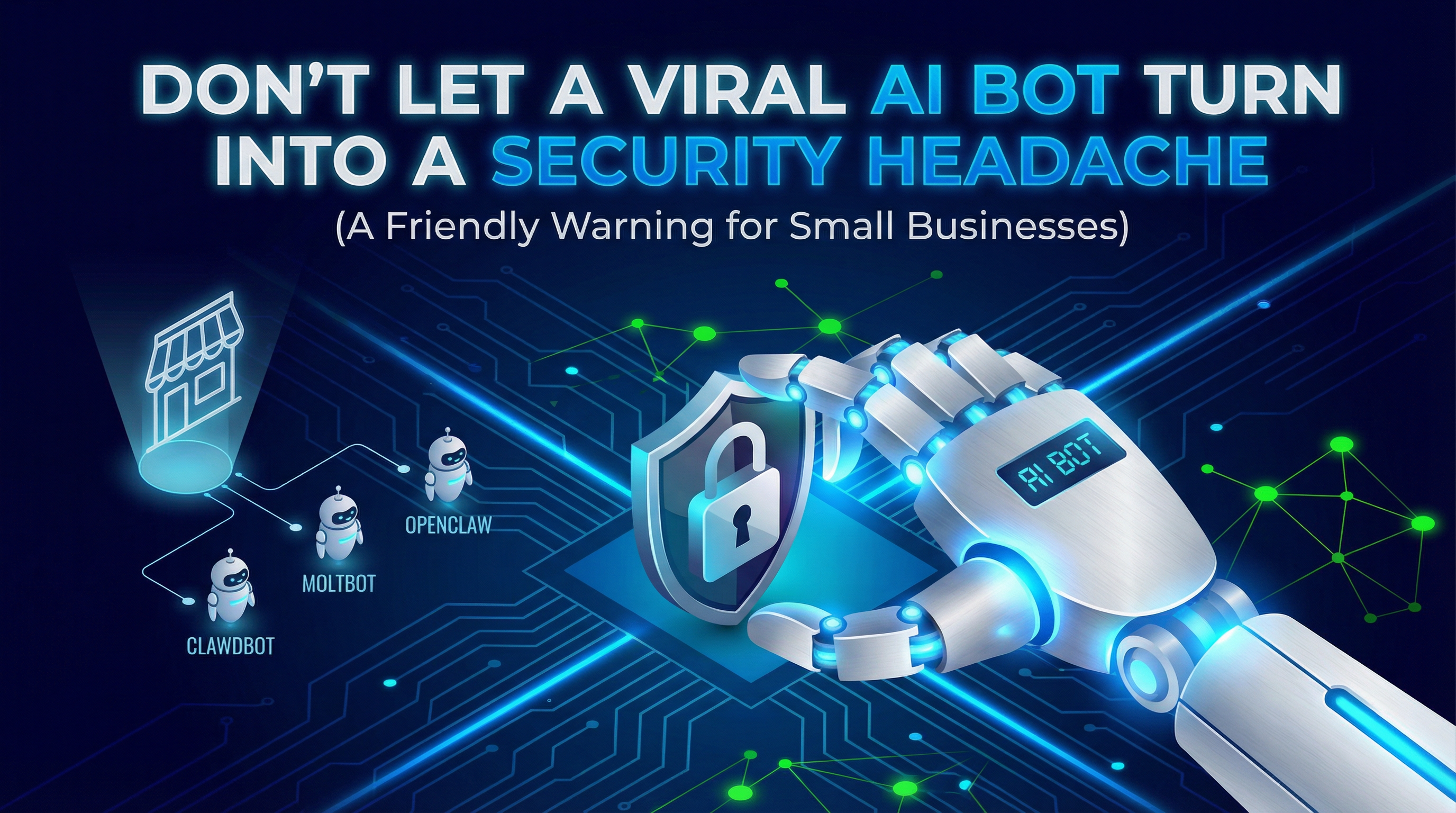
Right now, the “lobster bot” trend (often called Clawdbot, Moltbot, and now OpenClaw is one of the loudest examples. It’s getting attention because it looks like the future: an always-on assistant you can message like a person, and it can do work on your behalf. Tech outlets have covered the rapid rebrand and the hype wave around it.
Sources: TechCrunch, Business Insider :contentReference[oaicite:0]{index=0}
Here’s the problem:
The hype is real — and the security risk is also real. And for a typical 5–10 person shop, that risk can land on your lap fast.
This post is not meant to be technical, and it’s not meant to scare you away from AI. It’s a simple heads-up from a security-minded IT guy:
Don’t install “viral automation” tools the same way you try a new note-taking app.
What’s going on with “OpenClaw / Moltbot” (plain English)
This is a do-things-for-you AI assistant that can connect to tools you already use (like chat apps and other services). People like it because it feels simple: you “message the bot,” and the bot “does the work.”
Source: TechRadar :contentReference[oaicite:1]{index=1}
But behind the scenes, these kinds of assistants often need access to:
- accounts (email/chat)
- “keys” or logins (so they can connect to services)
- a computer/server that stays on
When something has access to your accounts, it’s no longer “just an app.” It’s closer to a new operator inside your business systems.
Why this trend turned into a mess so quickly
1) Name/brand chaos created perfect scam conditions
The project rapidly renamed from Clawdbot → Moltbot → OpenClaw, driven in part by a trademark request from Anthropic. That chaos created confusion, and confusion attracts scammers.
Source: Business Insider :contentReference[oaicite:2]{index=2}
There were also reports of scammers hijacking handles during the changeover and using the moment to push unrelated crypto hype.
Source: Business Insider :contentReference[oaicite:3]{index=3}
Small-business takeaway: when a product’s identity is changing daily, it becomes easier for fake accounts, fake “download links,” and “lookalike” pages to trick people.
2) Exposed dashboards and “oops” security mistakes happened at scale
Security reporting has pointed out that many installations were left accessible on the public internet, creating risk of sensitive data exposure.
Sources: Axios, Forbes :contentReference[oaicite:4]{index=4}
This is the part non-technical folks often miss:
Most security disasters aren’t “movie hacking.”
They’re everyday mistakes like:
A Friendly Warning for Small Businesses
- leaving something open
- using default settings
- trusting a random tutorial
- connecting real accounts before you’ve tested safely
3) “Vibe coding” + speed can outpace basic safety
This week, Reuters reported a major security issue involving Moltbook, a related “social network for AI agents,” where a cybersecurity firm found sensitive data exposure and the issue was patched after disclosure.
Source: Reuters :contentReference[oaicite:5]{index=5}
Different product, same lesson: fast-moving AI projects can ship before the guardrails are mature.
The “friendly warning” part (what I’d tell a busy SMB owner)
If you see a viral AI bot that promises automation, ask these three questions before you try it:
1) “Does this tool need access to my accounts?”
If the answer is yes (email, chat, files, calendars), treat it like granting access to a real staff member:
- would you give a brand-new hire full access on day one?
- would you give them the keys to everything with no oversight?
2) “Where does it run?”
If it runs somewhere you control (your own server, a hosted box, a cloud machine), that can be powerful — but it also means you become responsible for updates and safety settings.
Source: Forbes :contentReference[oaicite:6]{index=6}
3) “How would I know if something went wrong?”
If you can’t answer that simply (alerts, logs, who can access it, what it can touch), it’s not ready for your real accounts.
“So should I avoid it completely?”
Not necessarily.
But don’t test it on your real business first.
If you’re curious, do what professionals do with new tools:
- test with a throwaway account
- keep it separated from real customer data
- don’t connect it to “everything” on day one
That’s not being paranoid. That’s being practical.
My bottom line
The big idea behind these tools (message an assistant and it does the work) is real — and it’s coming fast.
But the current wave proves something important:
AI automation without guardrails becomes “shadow IT” overnight.
And shadow IT is how small businesses end up cleaning up messes they didn’t budget time or money for.
If you want automation that’s useful and safe, the path isn’t “install whatever is trending.”
The path is: small, controlled improvements with visibility and approvals.
That’s the whole FIT philosophy.
Sources & further reading
—————
If you’re an SMB owner and you’re exploring automation: start with one safe workflow, with approvals and logging. You’ll get the upside without gambling with your accounts.
📅 Book a call today!