The AI champion: the quiet role that makes adoption stick in small teams

"AI champion" sounds like an HR title that does not really exist. In small businesses, it gets dismissed as something only enterprises bother to assign.
"AI champion" sounds like an HR title that does not really exist. In small businesses, it gets dismissed as something only enterprises bother to assign.

Email is one of the highest-friction parts of running a small business. It is also one of the most practical places to introduce AI — not to fully automate your inbox, but to reduce the time you spend sorting, categorizing, and drafting responses.

One of the fastest ways to get inconsistent AI results across a team is to have every person write their own prompts from scratch each time. One of the fastest ways to fix that is a shared prompt library.

Micro-SMB work often starts in fragments: a voice note after a meeting, a quick Slack or Telegram message, an email you send to yourself, or a note captured on the go.

If you cannot measure your AI usage, you cannot manage it. Most small teams know they are using AI more, but cannot prove if it is actually improving outcomes.

Most micro-SMB websites are not broken. They are just unclear. Visitors land, skim, and leave because the offer is vague, the next step is not obvious, or common questions are unanswered.

If nobody owns the workflow after launch, automation quality decays fast. Adoption depends on clear handoff.
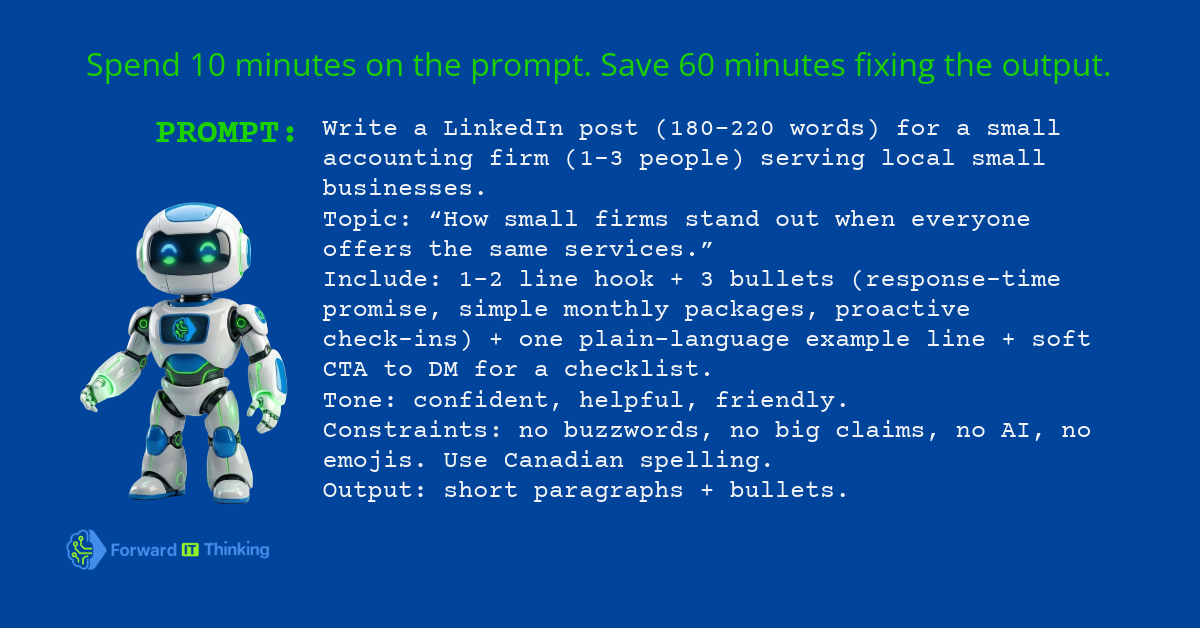
Most people don't get bad AI — they get vague prompts. This post gives you a practical prompting method that consistently produces usable output in the format you actually need.
The simplest way to make AI actually stick in your business — pick one task, build one golden prompt, and run it for 10 minutes a day for two weeks.

Ten ready-to-use prompts for small businesses that reduce busywork immediately — no tools, no integrations, just copy, paste, and get time back.