Writing for agents: SOPs your AI can actually run
Series: Building an AI-Ready Business — Part 2 of 3 Part 1: Process problem · Part 2: Writing SOPs · Part 3: Decision logs · Series hub
Most teams treat their SOPs as if they are ready to hand to an AI agent. They are not.
A human reading an SOP fills in the gaps. They know what "typically" means. They infer who "we" is. They ask a colleague when a step is ambiguous. An agent does none of that. Hand it the same document and it will stall, guess, or confidently do the wrong thing.
Writing for agents is the meta-skill that unblocks every automation pattern that comes later. The hype crowd skips it. This post does not.
Why human SOPs do not survive contact with an AI agent
Human SOPs use phrases like "use your judgment," "as needed," and "follow the usual process." Those are not instructions. They are placeholders for tribal knowledge.
An agent has no tribe. It cannot ask the senior person what the usual process actually is. When the SOP says "review for accuracy," the agent invents what accuracy means.
That is where automations break. Not at the model. At the procedure.
What makes a procedure agent-runnable
An agent-runnable SOP differs from a human SOP in one specific way. Every decision and every action is fully specified inside the document. Nothing depends on the reader already knowing.
That includes inputs, preconditions, decision rules, and the explicit handoff back to a human. If a sentence requires the reader to "just know" something, rewrite it until it does not.
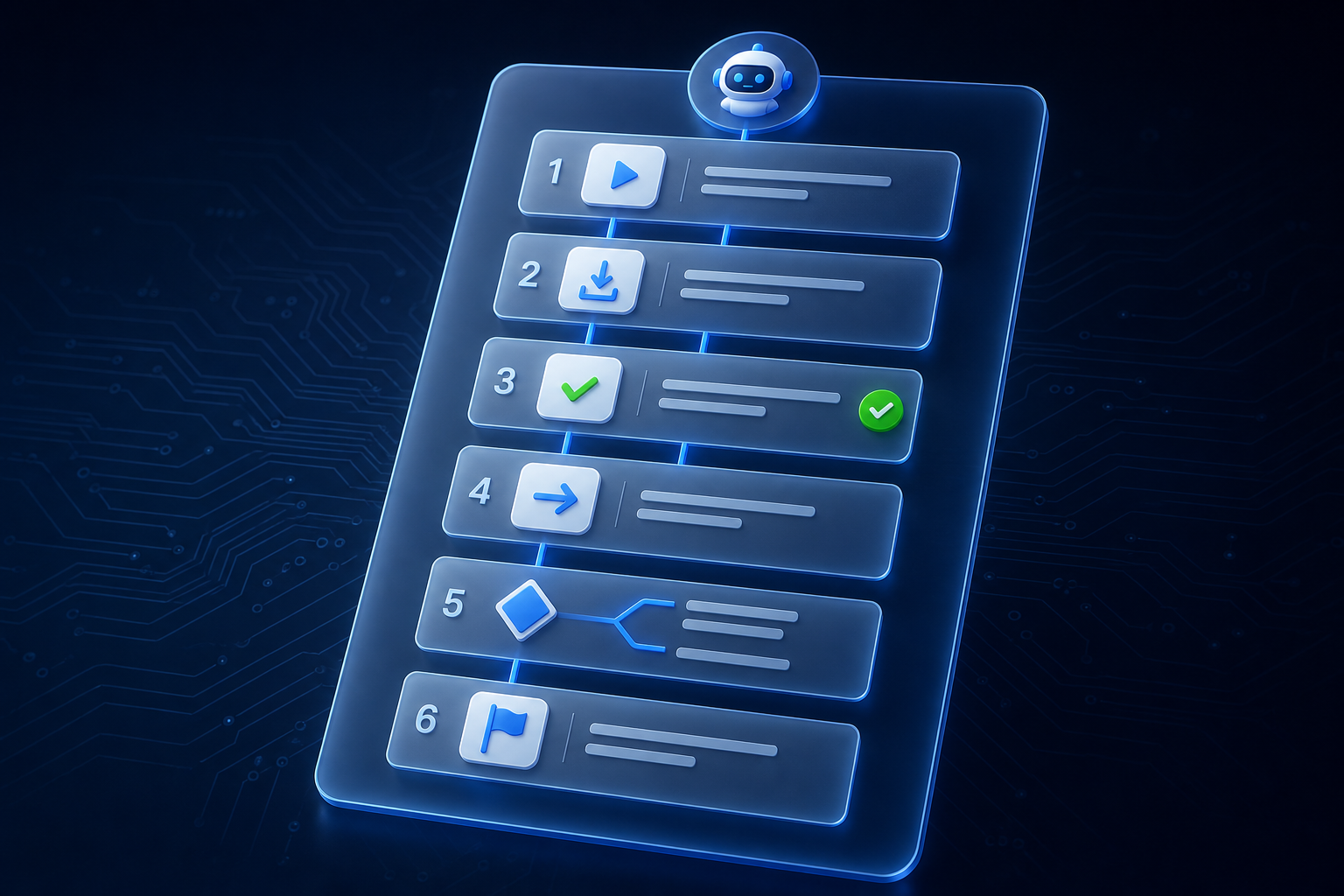
The six elements every agent-ready SOP needs
- Purpose. One sentence stating what the procedure produces.
- Inputs. The exact data the agent receives, and where it comes from.
- Preconditions. What must be true before the agent acts.
- Steps. Numbered, atomic, unambiguous. One action per step.
- Decision rules. Explicit branches with explicit criteria. No "judgment."
- Stop conditions. When to escalate to a human, and to whom.
If any of the six is missing, the agent will improvise. Improvisation is where governance and trust break down.
Patterns that break agents (and how to rewrite them)
- "Review for accuracy" becomes "Compare each line item in the invoice to the matching line in the purchase order. Flag any mismatch over $5."
- "Send to the appropriate person" becomes "If the request mentions billing, route to AP. If it mentions a technical issue, route to support. Otherwise, escalate to the team inbox."
- "Use the standard template" becomes a direct link to the template, the version number, and the fields the agent must fill.
The rewrite is always more verbose. That is the trade. Verbosity buys reliability.
A 22-person accounting firm tried to automate client intake using their existing onboarding SOP. The agent stalled on step three: "verify the client's industry classification." The SOP did not say where to find it. A senior accountant rewrote the step to specify the source document, the field name, and the fallback when the field was empty. The agent ran the procedure end to end the next day. The fix was editorial, not technical.
A reusable SOP template you can use this week
Copy this into a clean document and fill it in for one real procedure.
Purpose: [One sentence. What does this procedure produce?]

Trigger: [What starts this procedure? A new email, a form submission, a daily schedule?]

Inputs:
  - [Input 1: name, source, expected format]
  - [Input 2: name, source, expected format]

Preconditions:
  - [What must be true before the agent begins?]

Steps:
  1. [Atomic action. One verb. Specific object.]
  2. [Atomic action.]
  3. [Decision: If X, then step 4. If Y, then step 5.]
  4. [Atomic action.]
  5. [Atomic action.]

Decision rules:
  - [Criteria: when to choose path A vs path B. Be explicit.]

Stop conditions:
  - [Condition: when the agent must escalate.]
  - [Owner: who receives the escalation, and how.]

Output: [What the agent produces and where it lands.]
Run one real procedure through this template before any automation work. If you cannot fill every section without using "usually" or "judgment," the SOP is not ready and neither is the agent.
Keep exploring
Move on to Part 3: Decision logs — the one page that captures why your business does what it does. If mapping which workflows in your business are agent-ready is next, start the AI Readiness Audit or contact FIT.