The first 30 days as an AI champion: what to actually do
The AI champion sounds like a tools job. New software. New dashboards. New vendor calls. It is not.
The earlier post on the AI champion role covered why a small business needs one and who should hold it. This is the sequel: what you do in the first 30 days. The answer is not what most people expect.
If you spend month one buying software, you will spend month three unwinding mistakes. Spend month one mapping how work currently flows, and the rest of the year gets easier.
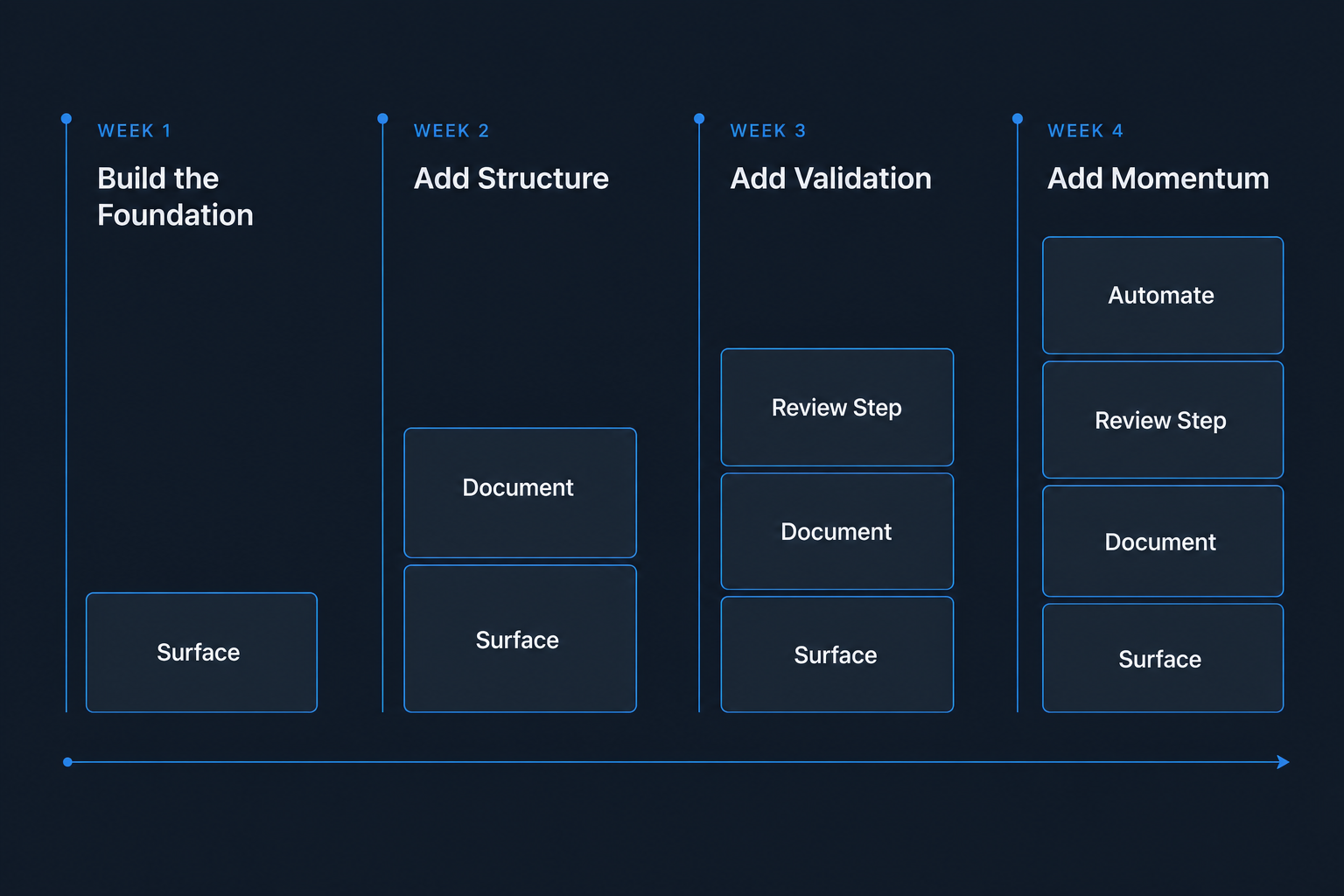
Week 1: Surface and pick one workflow
Your first job is to find the work, not buy a tool. Sit with two or three colleagues for thirty minutes each. Ask them which task they do every week that feels repetitive, brittle, or easy to mess up. You will get more candidates than you can use.
Pick one. A good candidate is bounded. It has a clear start, a clear end, and runs at least weekly. Something like processing a recurring vendor invoice, building a weekly sales summary, or sorting customer inquiries by topic.
The temptation will be to pick the most painful workflow. Resist it. Pick the workflow that is well-understood, low-risk, and produces a visible output. You are picking a first project, not solving the company's biggest problem.
Week 2: Document the workflow and run it manually
Write down every step. By hand, in plain language. Include the inputs, the decisions, and the outputs. Then run the workflow yourself, exactly as documented, at least once.
You will find gaps. Steps you do unconsciously. Decisions that are "obvious" only because the person doing them has done them 200 times. Capture those. The unconscious steps are precisely what AI cannot read your mind about.
This week's deliverable is a one-page document that someone new to your business could follow. If they can follow it, an AI assistant can be guided to follow it. If they cannot, neither can the AI.
Week 3: Identify the human review step
Decide where a human stays in the loop. This is not optional. Every AI-assisted workflow needs at least one point where a person confirms the output before it moves forward.
Look at your document from week 2. Where would a mistake be expensive, embarrassing, or hard to reverse? That is the review step. For invoice processing, it sits before payment is sent. For a sales summary, before the email goes to the partner. For inquiry triage, before the customer gets a reply.
Mark that step explicitly. Write down what the reviewer is checking for and how long it should take them. If review takes longer than doing the work manually, you have picked the wrong workflow or the wrong review point.
Week 4: Layer the first automation
Only now do you bring AI in. Pick one step from your documented workflow, not the whole thing, and apply an AI tool to that single step. Use whatever assistant your business already pays for. Do not buy new software this month.
Run the workflow end-to-end, with the AI doing one step and humans doing the rest. Compare it to the manual version from week 2. Track three things: time saved, errors introduced, and reviewer confidence. If reviewer confidence drops, slow down. The goal is reliable assistance, not speed.
By the end of the month, you have one workflow that is documented, partially automated, and reviewed by a human. That is more than most companies achieve in a year.
What not to do in month one
Do not buy a new AI platform. Do not roll a tool out to the whole team. Do not promise leadership measurable outcomes before week four. Do not pick the workflow with the most political weight. Do not skip documentation because "we all know how it works."
The first month is groundwork. Documentation, not tools. A single workflow, not a rollout. One review step, not a policy memo. That is not a productivity exercise. It is the foundation.
Keep exploring
The earlier post on the AI champion role at a small business explains why the role matters before you start month one. To identify which workflow to begin with, start the AI Readiness Audit or contact FIT.