Most SMBs don't have an AI problem: they have a process problem
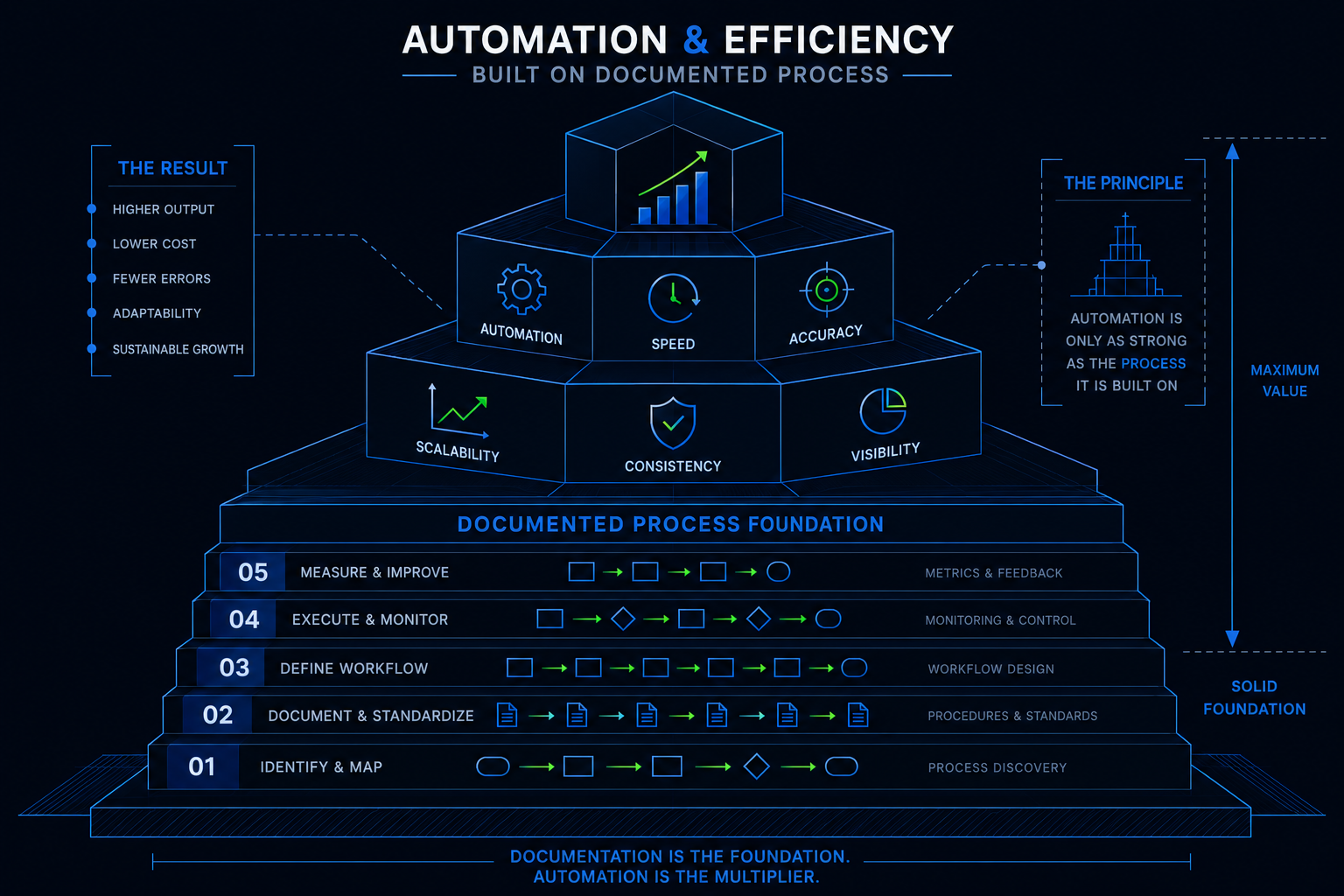
Series: Building an AI-Ready Business — Part 1 of 3 Part 1: Process problem · Part 2: Writing SOPs · Part 3: Decision logs · Series hub
AI is on every SMB owner's agenda right now, and the spend is climbing. What is missing is a quieter conversation about whether the work AI is meant to improve was ever stable enough to improve in the first place.
I keep seeing the same pattern. A five-figure tool, a six-month pilot, and nothing in production at the end of it. The tool is not the problem. The process underneath it is.
The pattern: budget approved, pilot launched, nothing shipped
The conversation always starts well. A vendor demo lands, an internal champion gets excited, the budget is approved. The pilot launches, two or three people get trained, and then the work stalls. Six months later, the tool is still installed and nobody is using it.
The post-mortems all sound the same. The team did not know which workflow to apply it to. The data it needed was scattered across three systems. The decisions it was supposed to assist with had never been written down. The AI did not fail. The process around it was never built.
Why AI amplifies what's already there
AI is an amplifier. That is the most useful way to think about it. Whatever you point it at, it speeds up.
If you point it at a clean, documented process, it gives you a faster, more consistent version of that process. If you point it at undocumented chaos, it gives you faster chaos. The same tool produces a great outcome at one business and a mess at another. The variable is not the AI. It is the process foundation underneath.
How to tell if you have a process problem, not an AI problem
Try this short test on any workflow you are thinking of automating.
Can a new hire follow the steps from a written document, with no shoulder-to-shoulder coaching? Do you know how long the workflow currently takes, end to end, on average? Is there one named owner for the workflow, and do they know they own it?
If the answer to any of those is no, automation is not the next move. Documentation is. AI applied to an undocumented workflow does not fix the workflow. It hides it.
Document, measure, then automate, in that order
The sequence is simple, and it holds up at every size of business.
First, document the workflow. One page is enough. List the trigger, the steps, the systems involved, the people who touch it, and the outcome. Plain language, no diagrams required.
Then measure it. Run the workflow as documented for two to four weeks. Track how long it takes, where it breaks, and what slips through. You will learn more from this two-week window than from any vendor demo.
Only then automate. By this point, you know what the AI is replacing, what it should not touch, and what good looks like. The investment lands because the target is clear.
Pick one workflow this week and start there
This does not need to be a quarter-long initiative. Pick one workflow that is genuinely repeatable: client onboarding, quote generation, invoice follow-up, lead intake, weekly reporting.
Take a 12-person professional services firm I worked with. Their AI tool budget had been signed off twice and stalled twice. We spent one afternoon documenting their quote-to-contract workflow on a single page. They ran it for three weeks. By the time we layered automation on top, the AI had a clear, measurable job. The pilot shipped in five weeks, not six months.
The shortcut is not skipping the process work. The shortcut is doing the process work first.
Keep exploring
Continue with Part 2: Writing for agents — SOPs your AI can actually run. If you are ready to map your readiness with a partner, start the AI Readiness Audit or contact FIT to talk it through.