Writing Markdown documentation AI agents can actually use
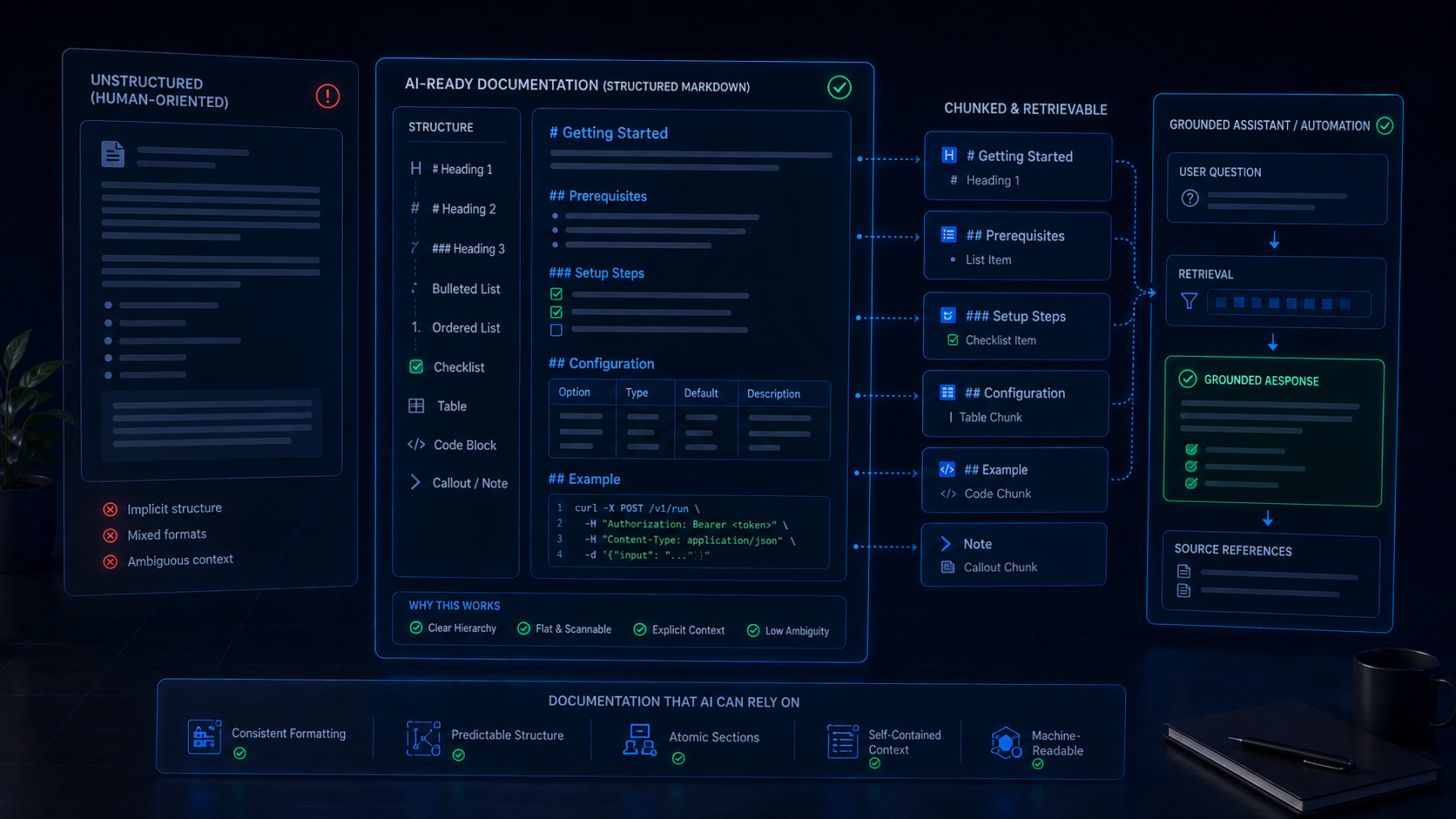
"AI-ready documentation" sounds like a tooling problem. It is a formatting problem.
Most internal docs are written for humans skimming on a Monday. They use visual hierarchy, mood, and inference to communicate. AI agents do none of that. They read structure, not style. When structure is missing, they guess.
That guess is where your automation breaks.
Why human-oriented docs fall short for AI agents
Humans read documentation like a map. They scan for landmarks, skip what feels familiar, and infer the rest from context.
Agents do not. They parse.
A page that opens with a clever headline, follows with three paragraphs of narrative, and buries the actual procedure in step seven works fine for a person. An agent reading the same page treats every paragraph as equal weight. It cannot tell the headline from the procedure. It will retrieve the wrong fragment, or it will retrieve everything and dilute its answer.
The problem is not the writing. It is the lack of structure the agent can rely on.
What makes Markdown the right fit for agent-readable docs
Markdown is plain text with explicit structure. Headings, lists, and code blocks all carry semantic meaning that survives copy, paste, retrieval, and chunking.
That matters because agents almost never read the whole document. They read fragments. A Markdown heading tells the agent "this is a section." A list tells it "these items belong together." A code block tells it "this is literal, do not rewrite it."
PDFs lose most of that. So do Word docs, Notion exports converted to HTML, and most proprietary wiki formats. Markdown is the smallest format that keeps meaning intact when the agent only sees a slice.
Core formatting principles: hierarchy, flatness, and explicit context
Three principles cover most of the ground.
Hierarchy must be honest. If a section sits at H3, everything inside it belongs to that section. Do not use heading levels for visual emphasis.
Stay flat where you can. Deep nesting confuses chunkers. Two or three heading levels is usually enough. If you need more, the page is probably two pages.
Be explicit about context. An agent retrieving a single paragraph has no memory of what came before. State the subject in the paragraph itself. "The retry policy applies when..." beats "It applies when..."
Add one more: avoid ambiguity. "Usually" and "in most cases" are fine for humans who can ask a follow-up. Agents cannot. Write the rule, then write the exception.
Before and after: rewriting a doc section for agent clarity
Before:
Our standard onboarding usually takes around a week, depending on the client. We typically start with a kickoff call and then move through the rest of the steps. Most of the time, the welcome email goes out on day one.
After:
Client onboarding timeline
- Day 1: Kickoff call. Welcome email sent.
- Days 2 to 4: Account provisioning and access setup.
- Day 5: Training session.
- Day 7: Handoff to account manager.
Exceptions: Enterprise clients add a security review on day 3.
The after version answers a question. The before version describes a feeling.
A quick checklist for agent-ready Markdown
Before publishing a doc your agents will read:
- Title and purpose are stated in the first two sentences.
- Headings reflect actual structure, not visual emphasis.
- No section depends on a previous section to make sense.
- Lists, tables, and code blocks are used where they fit the content.
- Exceptions are written as exceptions, not asides.
- One topic per page. Split when you find yourself using "meanwhile."
If you write deliberately for the agent, humans benefit too. Fewer surprises. Less guessing. More documentation that does its job.
Keep exploring
For related frameworks, read How to give AI the context it needs and Why AI doesn't know your business yet. If you are ready to structure your documentation for the agents you plan to deploy, take the AI Readiness Audit or contact FIT.